Tuesday, November 30, 2010

SKYPOMANIA

Skypomania – a chance to improve your network or just another device?

Skype™ software is a freeware that allows people and businesses to use Skype's voice-over-Internet-Protocol (VOIP) network. Using VOIP people can make voice calls over the Internet on their home or office PCs. Skype™ is the most successful VOIP network with more than 400 million users worldwide, boasting crystal-clear calls and free Skype-to-Skype calling anywhere in the world. In 2008 Skype™ software added a video feature, allowing callers with webcams to view each other live while chatting. Skype software doesn’t require any special hardware though a broadband connection is recommended. A contact list keeps other Skype users only a click away. The quality of the call is many times better than a standard phone line, and you can talk as long as you like for free. Calls are also encrypted, making Skype completely secure and private. (skype/wisegeek websites)

This blog post will show different attitudes as well as advantages and disadvantages of Skype.

R. Kayne from Business Networking.com tells us more about the advantages of Skype. If you have family, friends — or in the case of a business — non-local or even internationally, there is no cheaper or better way to communicate than free, using Skype software. No subscription or fees of any kind are required for this basic service of Skype-to-Skype calling. You can use your Skype software 24 hours a day, 7 days a week without limits or caps.

I find this to be very persuasive: The bigger and the more intercultural your network is, the more money skype is able to save for you. Who doesn´t know those expenisive landline calls from one continent to another? Video Calling, Instant Messaging, Phone or Mobile Calls and Skype Manager will enable you to connect the whole world. Even for your business Skype could be a perfect solution, not only to save money, but also to have the opportunity to make video calls and share data in a fast and secure way.

Although most of the users would say that Skype is a perfect way to save money, there are several people who disagree with this, e.g. Matthew Schieltz, e.how contributor. Skype requires your computer or laptop to be turned on and the software up and running in order to make calls. This is a huge disadvantage, as it prevents you from making and receiving calls when your computer is off. Skype officially endorses only two types of traditional land-line telephones that can be used with its service: the cordless RTX Dualphone handset and the Belkin Desktop Internet phone. Phones that use Wi-Fi technology and are specifically made for Skype users are options, but these options are extremely limited as well. No customer service number exists so that users can speak with a representative; there is only an online help form that allows Skype users to submit a support request. The limited customer service options for subscribed users of Skype is a huge disadvantage to individuals and especially business customers who may need help in times of emergency troubleshooting. Call quality from Skype may suffer if you have a slower-than-average Internet connection. Customers may also experience interference during calls if using a Skype WiFi or cordless phone from other devices such as routers, microwave ovens or even Bluetooth-enabled devices that operate at the same frequency.

Both parties are right, there are as usual advantages and disadvantages, but in my opinion it is a great opportunity to save costs and use the chances given by this device, especially for private users and small businesses. More and more devices are able to perform skype-software. Call your friends on all continents, share data immediately, take Skype with you as you have a 3G Phone. Nowadays Skype already commands 13 percent of international phone calls. Don´t think about costs, when you think of your network, friends or business contacts. There´s no excuse for yourself, now you have the technical device, so you should use them. In other words, you should better think of the chances you have within the right network. Your network is more important than you think, stay in contact, no matter where your contact is, might be the most important connector or boundary spanner you know.

Sources:

Business Networking.com

http://www.ehow.com/list_5907068_disadvantages-using-skype.html#ixzz16hI9w3uC

http://www.ehow.com/list_5907068_disadvantages-using-skype.html#ixzz16hHtHOaL

http://www.ehow.com/list_5939079_advantages-skype.html#ixzz16hHApiKv

http://www.ehow.com/list_5939079_advantages-skype.html#ixzz16hH3ZZ7B

http://www.nytimes.com/2009/09/01/technology/companies/01ebay.html

http://www.thecrimson.com/article/2008/9/17/harvard-couture-mr-livingston-was-conceived/

http://www.fudzilla.com/index.php?

http://www.skype.com

http://www.credit-suisse.com/skype-a-baltic-success-story

THE INQUISITR

Social Network Analysts Fight Terrorism

Since the 9/11 terrorist attacks, the United States and their alliance partners have been trying to destroy the responsible terrorist network named Al-Qaeda. After initial successes with the use of military power, the U.S. came to the conclusion that this means alone is not sufficient. Al-Qaeda is not a militarily structured unit and avoids battles that it cannot win. Additionally, to take out just the obvious elements – the fighting members of the network - will not destroy its underlying structure, which consists of parts such as leadership, training and all kinds of resources, for example material, weapons, communication equipment etc.

Social network analysis (SNA) can be used to collect crucial information from such a network. After 9/11, Valdis Krebs created a map to show the ties between the involved hijackers. Like Krebs, the Spanish sociologist Jose A. Rodriguez used public sources to draw a map visualizing the connections of the March 11th network, after the bombings in Madrid in 2004. Further analyses regarding Al-Qaeda were made by Marc Sageman. He used 172 biographies of known terrorists from different networks to show the ties among them. He discovered four geographic clusters of the network: around the Afghan-Pakistan border, in some Arab states, in the Maghreb in North Africa and in Indonesia and Malaysia. Many models of the network were created by academics but they were of limited use since the availability of trustworthy and complete data was not always sufficiently given.
The U.S. government has much more and better information than those entities using only publicly available data. Organizations such as the Central Intelligence Agency, the National Security Agency and the Department for Homeland Security use social network analyses.

Assuming that we have sufficient and correct data, how can SNA contribute to destroy a terrorist network better than other means? Nodes of the network with high centrality can be identiefied. They are potential points of failure and should be removed. It is favorable to eliminate them at the same time so that there is no time to replace nodes. Furthermore, individuals whose removal would disconnect groups can be identified. It is not just about to remove as many as you can but about to remove the important individuals. With that, a quicker implosion of the network is much more likely. And it is also a matter of time and resources one wants to spend on observation of the individual nodes of a network. Fellman and Wright call it to get the “most bang for the buck” - to cause the biggest possible damage with the given resources. Additionally, in groups were each member has strong ties to many other members, removing their leader would be of little effect. In contrast to that, members with a high connectivity and special skills are the weak points of a network.

After 9/11 SNA helped to prosecute terrorist. Unfortunately it could not prevent the attacks because these networks were hardly visible, since there were no ties between the hijackers and outsiders. But due to the strong ties within this network, the connections between them could be quickly identified after the attack.

Fellman P., Wright R., Modeling Terrorist Networks – Complex Systems at the Mid-Range, http://www.psych.lse.ac.uk/complexity/Conference/FellmanWright.pdf, viewed: 30 November 2010

Krebs V., Uncloaking Terrorist Networks, FM
Volume 7 Number 4 - 1 April 2002, http://firstmonday.org/htbin/cgiwrap/bin/ojs/index.php/fm/article/view/941/863, viewed: 30 November 2010

Ressler, S., Social Network Analysis as an Approach to Combat Terrorism: Past, Present, and Future Research, Homeland Security Affaris, 2006, http://www.hsaj.org, viewed: 30 November 2010

Monday, November 29, 2010

Is Facebook good for us?

A University of Texas research has suggested that Facebook is making us more social, albeit in ways unique to the digital age. The study, led by S. Craig Watkins, is the first to examine the distinct ways in which engagement with Facebook is evolving into a multi-faceted social experience. The findings indicate that Facebook is not supplanting face-to-face interactions among friends, family and colleagues. In fact, it believes that there is sufficient evidence that social media afford opportunities for new expressions of friendship, intimacy and community. Watkins surveyed 900 current college students and recent college graduates across the country to find out what and with whom these Facebook users communicate.

Being a student myself I can see the positive effects of Facebook that Watkins’ study describes. But what happens to other groups in our society, like children and teens; people that are in a different phase of their life? How do they need to handle the challenges that social networking brings?

According to the national association of independent schools, the greatest motivating factor for children to use technology in grades 7 and up is to connect to others; to socialize. Their irresistible need to connect with their peers, coupled with the development of 24/7 accessible technologies, can make the use of sites like Facebook all consuming. There are concerns for children and teens today growing up in a world where they are wired 24/7 without a break. For many of the kids there is little or no "down time." Some have difficulty disengaging from their social life. For some, it even raises their anxiety level to be without their cell phone connecting them to Facebook for a few hours! This is not healthy for them.

I must admit I was tempted to create an own Facebook page for my daughter, she is three and a half years old. I thought about posting some pictures, document how she develops in life and giving her the login when she starts high school. After reading many articles about negative effects of Facebook on children, I am somehow happy that I have not done this so far. I can understand that children can get easily overloaded in real life. Knowing how to make virtual friends and communication is one thing but not learning how to do this in real life can be quite a problem in personal development. When should children start with Facebook? Is not enough done to protect and educate children and teens against the risks that come from using the internet and Facebook in particular?

Parents of today have not an easy job, some decades ago the task was to explain the story with the bees and flowers; today it is how to use the internet and Facebook. I believe that parents would do well in showing openness to everything their children are interested, in order to understand and educate their children adequately. If we want or not, our children will grow up with social networks; our task is to educate and support them.

Reading issues concerning Facebook and children, I became curious if there are also other situations or phases in life, where Facebook can be more harmful to our relationships than helping them.

A recent Nielson survey (The Nielsen Company, 2010) states that we are now spending about 25 percent of our time online on social networking sites and blogs, which is up from about 16 percent in July 2009. A recent Angus Reid survey found that Canadians may be ignoring their significant others to spend more time using social media sites. According to the survey, 75 per cent of Canadians admit that checking social media sites is the last thing they do at night. And when they wake up? Partners are still getting the cold shoulder, as reaching for an electronic device to check email is first on the to-do list. In Toronto and Montreal, a whopping 80 per cent of people grab their mobile phones rather than their partners first thing in the morning.

These are shocking numbers. While focusing on Facebook friends, will we loose contact to people not on Facebook in the long run? Does Facebook influence the life of couples or even harm relationships? Is there a reason for my partner to be jealous if I add my good looking ex-girlfriend as a friend on Facebook? What about ethical aspect of using Facebook? Personally I have a friend connection on Facebook to somebody who is dead already. How to deal with such a situation? How do my friends deal with an automatic Facebook suggestion to add my dead friend as a new connection? This sounds bizarre but these kind of problems are probably just the tip of the iceberg. I believe that Facebook can influence a big part of our lives and in the long run the government will intervene in order to regulate some of the issues mentioned.

Nevertheless to conclude I think social networking sites such as Facebook are enrichment for the humanity and a very efficient way to communicate. But considering especially some of negative aspects afore mentioned it can be said that the relatively new trend of social networking leaves many open questions and uncertainties. I could imagine that for the average human there are many things which are new and strange or feeling uncomfortable. Like with everything in life it is important to keep the balance. Facebook works for me by helping me keep alive all weaker relationships, some of which I might be able to revitalize in times to come. And that's good enough for me. However, I think we are just at the beginning of a networking trend and will rapidly develop further evolutions with every new technological achievement. Today it might be sharing the location and living in Facebook only, but how about tomorrow? How far away are we from living in The Matrix? ;)


Sources:

http://www.ctv.ca/CTVNews/SciTech/20101124/social-media-studies-101128/

http://www.nais.org/resources/article.cfm?ItemNumber=151505

http://www.gulf-daily-news.com/NewsDetails.aspx?storyid=292682

http://www.andhranews.net/Technology/2010/Facebook-strengthening-our-social-ties-Study-1247.htm

http://www.huffingtonpost.com/lisa-haisha/children-facebook-addiction_b_788251.html

http://www.irishtimes.com/newspaper/finance/2010/1126/1224284180450.html

Online social networks and networks in general can be used to fulfill a variety of needs. As described by Schmidt (2006) cited by Poller (2008) they can support humans to interact, collaborate and communicate. Support is given through three basic functions: information management, identification management and relationship management.

This blog is going to discuss the concept of sharing information on the web and in social networks and using it as a communication medium to support or block ideas or initiatives. There are many controversies about the information available through online social networks and many groupings participate in them for example social activist &political groups.

One very controversial and current issue in Germany is Stuttgart 21, a group formed to stop the construction of a new train station in Germany. This initiative takes advantage of the possibilities of creating a network (Group on Facebok) of opponents to organize demonstrations and mobilize further followers mobilize followers (http://www.kopfbahnhof-21.de/).

But what happens if small minority groupings create website with racist’s content. Nazis for example are able to communicate and reach many more people than they have been able to in the past. Especially teenagers can be attracted through Facebook and StudiVZ, enabling Nazis to convince further followers of their racist’s ideologies (Lutz, 2010).

Furthermore, social networks enable politicians to reach new potential voters. An example is the election of the president in Germany this year, candidate Gauck who started as an outsider in the election was able to gain popularity through presence in social networks (Klopp, 2010). Does this additional information really improve the reader’s knowledge about the political scene?

Although controversial information can be shared, an online social network can also be used for the development of new ideas, connecting specialist and improving current processes.

As an example, the ministry of Education and Research (BMBF) in Germany took advantage of an online platform/network in order to eliminate weaknesses of regional innovation deficits (Aderhold, 2004). The project was called InnoRegio (ended around 2005), the initiative was hoped to have positive effects on regional development and the creation of a sustainable innovation strategy, see also http://www.bmbf.de/de/1277.php

Another governmental initiative of online networks is being used to link schools, kindergardens, social services for teenagers and apprentice’s alliances to establish a broadly applied learning culture in Germany (Aderhold, 2004).

The point is that the usability of online social network and its corresponding benefit for society depends on the content of the portrayed message. While negative forces can abuse it, it can help to connect groups that otherwise would not be able to learn and profit from each other. The immense availability of information on the internet creates the necessity of groups with common interest to join and leverage their knowledge. In the end, social networks enable people to connect and make information available to each other, important is that the reader has the repsonsibility to judge whether this information is "correct" or "ethical".

References:
Aderhold, J. (2004) From und Funktion sozialer Netzwerke in Wirtschaft und Gesellschafft: Beziehungsgeflechte als Vermittler zwischen Erreichbarkeit und Zugaengikeit. Wiesbaden: VS Verlag fuer Soziale Wissenschafte.

Klopp, Tina (2010) In sozialen Netzwerken fiebern die Menschen mit [WWW] Die Zeit. Available from: http://www.zeit.de/digital/internet/2010-06/twitter-facebook-for-president [Accessed 26/11/2010]

Lutz, Martin (2010) Die NPD unterwandert Facebook und Studivz [WWW] Welt Online. Available from: http://www.welt.de/politik/deutschland/article7087244/Die-NPD-unterwandert-Facebook-und-StudiVZ.html [Accessed 26/11/2010]

Poller, Andreas (2008) Privatsphaerenschutz in Sozialen-Netzwerke-Plattformen [WWW] Frauenhofer Institut Sichere Informations-technologie. Available from: http://www.sit.fraunhofer.de/Images/SocNetStudie_Deu_Final_tcm501-35966.pdf [Accessed 26/11/2010]

Sunday, November 28, 2010

Social Media for Recruiting

Paul Jacobs describes social recruiting as follows: SR is delivering sound hiring decisions by actively using web-based technologies to build a shared understanding between employers/recruiters and passive and active job seekers. But it is still the question where does the real social recruiting start, what is social in that content and how much are the participants benefiting from this? Is it already social to post a vacancy on a social networking site or to place a creative banner ad on a social networking platform? The author thinks not and gives an example how social recruitment could look like, for instance an online event that includes live-streaming video with micro-blogging. In order to use the new tool social recruitment efficiently, a kind of interactivity between the employers/ recruiters and the jobseekers is necessary. Therefore, the recruiters have to find the niches of the potential employees; they have to know in which social network their clients are active in and how to reach them. He thinks that it is not a question that social recruitment is highly relevant for the future tasks of recruiters.
The knowledge of best-practice-approach still has to be find out by social network analysis, studies, etc. in order to meet this trend timely and adequately. Companies have to develop their social recruitment strategy for being professional and successful in this field. Who’s responsible for the blogs, what should be the content and how much time/ investment is reasonable? These are questions companies have to answer before joining the bandwagon.

That’s the topic of Brent Pearson’s article which describes some critical points concerning social recruiting. He cautions the recruiters against the overheated trend. For him, the hype of SR brings up the question which priority the new tool has in comparison to other recruiting tools like a career site. Having other initiatives perfect first makes it worth to use the tool of SR in addition or as supplement, especially for sourcing. He describes seven points he considers as important when initiating SR in a company:
1. Start using social ,media sites for sourcing immediately
2. Combine different, attractive tools of recruiting
3. Make sure your recruitment house is in order
4. Think carefully about the ongoing investment required
5. Measure your return on investment
6. Be a fast follower
7. Avoid a hype
Furthermore, the recruiters have to pay attention for the pitfalls, social media site provide, for instance the privacy. Jobseekers/ applicants see sites like facebook as “personal space” and a misuse of these data’s could damage an employer’s brand.
From my point of view the above-mentioned articles show how much uncertainty exists concerning social recruiting. On the one hand, there’s the pressure of being a fast follower, not to miss a trend in order to get the best employees in the “war for talents”. On the other hand there are still so many open questions. How to measure the success of social recruiting, how to address the right people in the right way, and altogether: Is it worth to put so much effort to a topic that might be unimportant in two years? While the first article questions and defines the scope of social recruiting, the second one gives a kind of guideline what to consider concerning social recruiting. Both are helpful to evaluate the hype a little bit better and could help recruiters/ employers to a possible strategy.
Since social recruiting is still a quite new topic, it is still in progress of improving. The first companies already collect some experiences. Their success and failure will show how big the potential of the current hype “social recruiting” really is. It is incontestable that the social media networks are growing, especially facebook and Twitter or to have a look at the professional sites LinkedIn. With the help of some special equipment and tools it might be possible to use the huge source of social networks in a more efficient way for recruiting.
Sources:
Human Resources Magazine, December 2009, Brent Pearson, Social media for recruitment, p.6-7
Human Resources Magazine, December 2009, Linda Coles, Using social networking sites, p.4-5
Human Resources Magazine, December 2009, Paul Jacobs, What is social recruiting?, p.2-3
http://www.stepstonesolutions.de/_pdf/News/Whitepaper_Social_Networking-Seiten_als_Recruiting-Werkzeug.pdf
http://www.talential.com/blog/online-recruiting/social-recruiting-2010-soziale-evolution-aber-keine-twitter-revolution/

How to start using social networks for established businesses effectively?

Jean-Marc Gales, head of the Peugeot and Citroen brands, said in an interview to a German business magazine “Looking at the amount of employed people, Facebook will become the largest country worldwide in the upcoming years. How the automotive industry should deal with this challenge is an important question, which has not been answered yet”. In this context it is considered that Facebook and its user community will become a more and more important opinion-former, which will finally impact buying decisions and customer satisfaction for cars.

At the first glance, the statement of Jean-Marc Gales does not sound revolutionary or frightening, but after thinking about it for a while or doing some research it can be confirmed, that no clear concepts have been established yet. After a quick check of the world’s top ten car manufacturers and their presence in Facebook it turned out, that only Volkswagen and Mercedes seem to have an official page representing their brand and promoting some of their products. All other car producers are represented with fan pages or country specific dealer pages only.

Not all PR professionals seem to share the opinion of Jean-Marc Gales. A survey conducted among 107 PR professionals beginning of 2010 finds, that the importance of social networks is rated between two and three on a scale from one (not important) to five (very important). Furthermore “making use of social community networks” was rated as thirteenth out of 14 possible online PR priorities for the future. Reasons for these results might be different and will not be evaluated further, but linking back to the beginning of this blog entry it reflects the reality.

The conclusion of these different sources is that executives start to understand the increasing importance of social networks for their businesses, but holistic concepts and the implementation of these do not exist yet. From my point of view a number of important questions need to be answered before starting to be active in global social networks like Facebook or others. When having a holistic concept and the capabilities to maintain a social community an implementation can be started. The relevance and urgency of these topics for different industries might be subject of further discussions.

Sources:
http://www.handelsblatt.com/unternehmen/it-medien/auftritt-im-netz-das-grosse-raetsel-facebook;2694956;0

http://www.newventurepublishing.co.uk/newsletter.php?issue=14&PHPSESSID=3f6e0148416bf3b41896022aaa8616ba

http://www.destinationcrm.com/Articles/CRM-News/Daily-News/The-6-Hidden-Dangers-of-Social-Media-69145.aspx

http://www.destinationcrm.com/Articles/CRM-News/Daily-News/Whats-the-Most-Popular-Industry-on-Social-Networks-69978.aspx

http://www.goso.com/2010-goso-social-media-report.pdf

Relevance of social networks during a demonstration (on the example of the castor transport in Germany)

It is long ago since preparation and mobilisation of people for a demonstration moved to the Internet. Lots of webpages inform protester and follower about possible dates and places, but the organization and communication during the demonstration has been very difficult in the past. Information about different situations and needs in the camps and on the castor transport way have to be transmitted via phone calls or even motorbike couriers. This was very time and cost consuming. It was also not easy to inform the public about happenings on the demonstration.

But finally social networks helped to reorganize information flow. Since the last castor transport two years ago the number of Facebook user grew by 10 Million and per year five million more smartphones have been sold. Most of the protester are always online and exactly know where they are and where others are.

This leads to a new quality of protests. Mobile phones are one the one hand reporter of the happening and connect the actor with the whole world of follower that support the demonstration and on the other hand it is a cheap and universal tool for communication during demonstration.

The Police have their strict rules for communication and it is transmitted via their secured radio. Troops have to report their location and happening. In the command centre the information is assembled centralized and new instructions are given to the troops. In the former times they had a big advantage because the command centre had an overview over the demonstration and could react fast to demonstration movements. But did they develop further? In Germany the police did not manage to switch to digital radio what could help in these situations.

Today most of the protester post there information and location live in the Internet and special web pages display and sort the tweets it is very easy to follow the wave of protest and know which place is most interesting for a protester to support his colleagues. Information Flow is optimized and protester seam fully in advantage but also the Police is not sleeping and so it is also scanning that information. Even appeals are traced and so the department of public prosecution is searching for people that call for illegal actions.

So what would be the future? How will it look like in 5 or 10 years? Will it be a cyber war like in since fiction movies? Who will be faster police or protester? Will there be an Information overflow and spamming and can this be contra productive? Which conclusions can companies draw from that?

In my opinion the major task during a demonstration is to filter and sort the information in order to prevent an information overflow. But hopefully the police can close the gap and prevent protester from overreact to their information advantage.

Sources:

http://blog.zeit.de/open-data/2010/11/05/live-web-der-castortransport-bei-twitter-kartiert/

http://www.spiegel.de/netzwelt/web/0,1518,727610,00.html

http://www.badische-zeitung.de/deutschland-1/castor-transport-satter-protest-hungrige-polizei--37516162.html

http://live-map.de/

http://castorticker.de/zeitmaschine

http://www.anti-atom-demo.de/start/mobilisieren/soziale-netzwerke/

The impact of networks to the career of business students

There are many reasons why business students can be successful in their later career life in business. They can have certain attributes or abilities that allow them to be successful. But also their networks have a big impact on their success. But which part is actually more important? Is it more important to have a good network or have a good professional competence?

First of all it is important to distinguish between objective and subjective success in career life. Objective career success is observable career accomplishment, which can be reliably judged by others. Examples for objective career success would be an increase in compensation or ascendancy. In comparison to objective career success, subjective career success more refers to individual appraisals of one’s career success. Several studies showed that networking refers to subjective and objective success factors (Forret & Dougherty, 2004; Langford, 2000; Michael & Yukl, 1993; Orpen, 1996). So I can concentrate on networking as a whole and do not have to distinguish between them.

Mark Cummuta, who is called the new pope of networking, says that networking needs to be effective, consistent and dedicated. With effective he is not referring to the quality of networks, but rather to the quality. He states that to have good network contacts is by far the most important point of all in order to have a good career. He also refers to a Chinese word “Guanxi” which stands for relationships among people. The basic idea behind is to give knowledge to other people without expecting anything back for this directly. One should be aware of the fact, that one day it will be rewarded. In order to give this a certain structure, Chinese students often often connect in an early stage of their careers in these Guanxi. Those ties are often stronger than the ties to the company. Networking is also the most effective way to secure professional positions. There seems to be a big correlation between the thickness of the tie and the network value. It is therefore very important to take care of the network. Therefore it is necessary to be proactive to maintain networks. If people just contact the person when they need them, this seems to be not a very successful strategy.

But for sure there are good arguments against that whole networking hype. John Agno, who is coach for leadership skills, argues that it more effective to achieve the goals for the career without networking, just by simple doing the job with good hard skills. He states that hard skills are as effective to get the reputation in the company to be a hard working, trustworthy employee. He is by the way one of the few who also concentrates on the benefit of the company and not only on his own benefit. He uses networks only for the exchange of knowledge and ideas. I think that in that whole discussion about weather networks are important or not, most people do not pay much attention to this aspect. Another aspect that is mostly overseen in this discussion is that some people are better communicators than others and it is easier for them to do networking.

What can we conclude from that? If you ask London Business School what is the biggest impact for your career, they say: “From one-week Executive Education courses through to our full-time, 15 to 21-month MBA programme, studying at London Business School will equip you with the skills, knowledge and networks to assist you in realizing your potential.” Similar results occur if you go to other business schools. So for them the network is as important as important as skills and knowledge. I totally agree with that and I would conclude that in the end a mix of both, networking and hard skills is the best way of doing things. If a person just hangs out at networking events without spending time on his desk or the other way round, he is not going to be as successful as he could be. I think that a mix of those three aspects will lead to the biggest success.

http://www.cio.de/karriere/personalfuehrung/850622/

http://www.laser.uni-erlangen.de/papers/paper/72.pdf

http://www.articlesbase.com/careers-articles/does-social-networking-have-a-good-impact-to-your-career-search-1529322.html

http://belladomain.files.wordpress.com/2010/05/effective_networker_study.pdf

http://www.london.edu/theschool/careerimpact.html

Wednesday, November 24, 2010

The Myth of Six Degrees of Separation

What do Santa Claus and six degrees of separation have in common? People around the world believe in them. Since we wouldn’t dare to argue about Santa Claus, we will discuss the six degrees of separation theory instead.

The six degrees of separation theory is based on research conducted by Stanley Milgram in the 1960s and 70s. Milgram wanted to learn more about the probability that two randomly selected people would know each other. In his most famous experiment, Milgram chose about 300 individuals in several U.S. cities to be the starting points and Boston, Massachusetts to be the end point of a chain of correspondence. Information packets were initially sent to "randomly" selected individuals. They included letters, which detailed the study's purpose and basic information about a target contact person in Boston. Upon receiving the invitation to participate, the recipient was asked whether he or she personally knew the contact person described in the letter. If so, the person should forward the letter directly to that person. In the more likely case that the person did not personally know the target, then the person was to send it to a friend or relative they know personally that is more likely to know the target. When the letter eventually reached the contact person in Boston, the researchers counted the number of times it had been forwarded from person to person. Among these chains, the average path length fell around 5.5. Hence, the researchers concluded that people in the United States are separated by about six people on average.

The research was groundbreaking in that it suggested that human society is a small world type network characterized by short path lengths. Milgram’s view of the problem was to imagine the population as a social network and attempt to find the average path length between any two nodes. Although Milgram himself never used the phrase "six degrees of separation", these findings are likely to have contributed to its widespread acceptance.

In the intervening decades, Milgram's findings have slipped away from their scientific moorings and sailed into the world of imagination, says Judith Kleinfeld from University of Alaska Fairbanks. According to her, Milgram's startling conclusion turned out to rest on scanty evidence and the idea of "six degrees of separation" might be the academic equivalent of an urban myth. Also Ivan Misner, author of several books about human networks, calls it a widely held belief that just isn’t true. He states that the overwhelming majority of people in Milgram's studies never got the material to the intended recipient. This is, in fact, correct because only 64 out of 296 letters in Milgram’s experiment arrived at the destination, what corresponds to about 20 %. In Milgram’s first, unpublished study, only 3 of 60 letters - 5 percent - made it. The high number of lost letters puts a big question mark at Milgram’s results. Every lost letter might indicate a longer chain, because the longer the chain, the more unlikely the final arrival of the letter (and vice versa). After all, this means, that the average degree of separation might be considerably higher than six.

When looking for more recent examples of the six degrees research, we can’t skip online communities like Facebook or Twitter. A Facebook platform application named "Six Degrees" was developed by Karl Bunyan, which calculated the degrees of separation between different people. The average separation for all 5.8 million users of the application was 5.73 degrees, whereas the maximum degree of separation was 12. In June 2009, Bunyan shut down the application, presumably due to issues with Facebook's caching policy. Users on Twitter can follow other users creating a network. According to a study of 5.2 billion such relationships by the social media monitoring firm Sysomos, the average distance on Twitter is 4.67. On average, about 50% of people on Twitter are only four steps away from each other, while nearly everyone is five steps away. Care has to be taken when, when generalizing the degree numbers of Facebook and Twitter. These networks generally consist of a specific group of mainly young people who are extremely well connected. The overall society contains many people who are not connected by electronic communities and who might even not be connected to the internet at all. Therefore, the degree of the overall society should be significantly higher than the degree of the online communities.

We can conclude that the exact degree of separation of our society remains unknown. Experiments have had weaknesses and a perfect model for our heterogeneous society has not been found and might even not exist. The degrees of online networks give us a good indication but only represent a specific part of the population. Also, we must state, that the degree of separation is probably not constant in time, which results in further questions. How much do electronic communication and online networks contribute towards a decreasing degree of separation? On the other hand, does the growing world population tend to increase the degree of separation? Maybe Santa Claus can give some answers.

Sources:

Stanley Milgram, "The Small World Problem", Psychology Today, 1967

Ithiel de Sola Pool, Manfred Kochen, "Contacts and Influence", Social Networks 1(1), 1978

Ivan Misner, “Debunking the Six Degrees of Separation”, 2007, http://www.entrepreneur.com/marketing/networking/article177986.html

Judith Kleinfeld, “Six Degrees of Separation: An Urban Myth?”, Psychology Today, 2001, http://www.judithkleinfeld.com/ar_sixdegrees.html

Sebastian Schnettler, "Mythos Kleine Welt", 2008, http://www.wiso-net.de/webcgi?START=A20&T_FORMAT=5&DOKM=1521297_ZDZI_0&TREFFER_NR=2&WID=80142-7200440-13224_10

Social Networking goes mobile

Social Networking goes mobile

“Picture this: a young woman goes to a party. She doesn't know anyone but it's fine because she has her mobile with her. A few clicks and she accesses the profiles of a dozen people at the party, including their pictures. She's in luck: two of them turn out to be friends of friends. She messages them and they start to chat.”

With this paragraph the author Mike Harvey starts his article “The future of social networking: mobile phones” , which was posted in May 2008 (http://technology.timesonline.co.uk/tol/news/tech_and_web/article3897340.ece). As per opinion of the author,social networking via mobiles is next step after the internet based social networking (MySpace, Facebook).

As an example of a company who provides social networking via mobiles, the author refers to “aka- aki” , which is based in Berlin. This company brought internet and GPS/ Bluetooth technologies together and created the application which allows its users to define the location of “aka-aki” users just from their mobile phones. In other words, the user who has an app on his mobile phone, get the signal when someone from “aka-aki” mutual friends or other memebers are nearby. Then, the user can check the profile of the person, look to the interests, send a message, etc.

In 2008 “aka- aki” had 3,000 members. This number increased up to 500,000 members in March 2010 (http://eu.techcrunch.com/2010/03/16/mobile-social-network-aka-aki-hits-500000-members/) and 600,000 in September 2010 (http://www.worldtech24.com/gps/aka-aki-600000-members-social-network-and-soon-game).
And "aka-aki" is not the only one who offers this service. Basic conclusion we can withdraw is that people of the 21st century are moving towards the social networking via mobiles. They are more relaxed about sharing their information and being involved into the chat or conversation with strangers who are just couple of meters away from them.

I think that the idea to bring the social networking from PCs into the people’s “pockets” is a great one. People can connect to each other anytime and anywhere. The access to people, to information has become easier and faster. Today, mobile phones applications on social network are just fancy and cool, but tomorrow they may become a way of buiding the network and the style of life.

Thursday, November 18, 2010

Possible reasons for all our findings

Morning everyone,

figures and the related charts are one thing. But these things don't tell us anything about how this network developed.

Why are the consultant company in Europe? Since when? What was the main idea behind it?

- Maybe for a short time?
- Maybe for special purpose?
- Because of that only one partner has a connection to all europe people, maybe it is his baby to grow the company to europe

An other thing is the comparison of US versus Europe. In my opinion the more intensive connectivity in US can be explained because every US-employee has his office in Boston, maybe in the same building. In Europe the employees split over borders and different cultures.

My suggestion would be focus on core competence (US, all fields without IT) and work on the communication on the partner-level.


Wednesday, November 17, 2010

Distribution as per practice:
Connection are analyzed based on the regions within the same practices
Health care: all in US, only 2 connected to each other
Government: 5 in Europe, and 1 in US, however the connection is only between 4 Europeans
IT: only two, and both in Europe. No connection to each other
Oil and Gas: majority in US and all connected this or that way. Only two in Europe, not connected to each other or to US
Pharmaceutical: the same , as with oil and gas. There is only one person in Europe, who is not connected to no one from the same practice.
Industry: Connections within the region is much better in comparison to the all previous practices. However, the connection between the regions only via 2 people, one from Europe, one from US.

More about the gender issue: Statistical Analysis

The point about women not playing a big role can also be proven through a small statistical analysis:


It shows that with a 95% of confidence someone is more likely to be a Managing Consultant when his gender is Male, practices in Pharmaceuticals and lives in Rome, all the other combinations won't change this too much.

Summary of the activity: Main points for tomorrow.

Summarizing the main points presented today, for tomorrow’s assignment the main points would be:

1. Women do not play a big role

2. Europe does not have Pharmaceutical practice, and US does not have IT

3. Europe office should increase level of interaction among workers and reduce the hierarchic working style

4. US should connect more with Europe

5. Associates in Europe are not as well connected as in the US

6. Contacts and knowledge are not leveraged internationally

7. ER, HB, and CD should be taken into consideration prior to any change initiative since they are the higher betweness and highest degree.

8. Change the organizational structure. Hire new talent

Problems & Recommendations


Dear all


Let's have a look at this interesting picture. Firstly I dichtomized the data and only kept the connections whose values were greater or equal to 4. Then I colored it by the attribute of practice and analysed the betweeness of those nodes. I noticed that those people who practiced in pharmaceutical business had more connections than others. And in USA, there were more staff whose practics were pharmaceutical than Europe. The only person in Europe who practiced pharmaceutical had zero connection value greater than 4.
So maybe this company has problems to cross-practice train its staff and it doesn't utilize its internal resources efficiently. The European pharmaceutical market is nearby as large as US, but obviously the company has a power in this area in US, but not the story in EU. So the company can launch more trainning sessions for people who do the same practice and aslo cross-practice train its staff in order to upgrade its staff competitive advantages.

Consulting Company without pyramid structure!

Dear all,

after reading all these valuable comments I would like to point out one consulting specific characteristic. Successful consulting companies usually have a pyramid structure. The levels with the highest headcount should be Consultants and Assistants, the lowest number should be partner and manager. The given structure shows the opposite and it is difficult for junior high potentials to go-up, thus they have bad career perspectives and leave the company.


A solution is to manage the pyramide:
- fire senoir people which perform below average
- promote high potentials
- hire new high potentials


Best regards
Denis

Hierarchy-Gender, Practise-Region/ Location

Hello All,
Few more inputs with recommendation:
Observation 1:
There are 4 Partners- 3 male (BC, HA, WD) and 1 female (RL). However, there is no communication between the male partners and the female partner, irrespective of feasible conditions such as BC being partner from same region (EU) as that of RL, and both of them practising in the same industry and location. There seems to be a major disconnect between partners RL and BC, probably due to rivalry which poses significant disadvantage to RL.


Red: Male Blue: Female
Recommendation 1:
Either the female partner should have connection with BC and hence indirect connection to US or should have direct connection to one of the partners in US, which in turn would have indirect connection with the remaining two partners. The female partner should be included in communication with other partners.


Note: Partners' links to different industries and locations are important in getting business to the company.

Observation 2:

It can be seen that the important practise which connects EU to US is the industrial sector. Removing the industrial link from the locations would disconnect links of different practises internally within EU and externally with US.
Blue: USA Red: Europe
Recommendation 2:
The EU industrial practise should sustain its strong connection within and outside EU. Also, other practises should expand their connections with different sectors and hence not rely only on industrial sector for its connections.

Cya tomorrow.

Cheers,
Apoorva

Identification of Key Players


Highest Degree = 45

These three persons have collaborated with the highest amount of people in the last three months.

Lower Closeness Centrality = 91.000

These are the three persons that can reach everyone in the network fastest

Higher Betweenness = 82.428

These three persons are often the shortest path between two other people

Highest Eigenvector = 0.226

These are the three persons that are best connected to other well connected people


These key players shouldbe selected to intervine prior to any change initiative.

Hierarchy stuff


I´ve added another column in the attribute (hierarchy level 4 up and gender) and came up with the result, that all hubs are on hierarchy level of 4 or higher are male. So most of the upper hierarchy level employees are male.
If you compare the networks of upper and lower hierarchy level, it seems like employees from lower levels are not that highly motivated:
Without having a mentor within the company, you´d better be the smartest person, very lucky or satisfied with your position without putting too much effort in your job.
Simon

Female Communications Skills

The company has either to train its emplyees in communication skills or hire more women to build a good network.
Simon

Researchers

In Paris, Rome and Oslo are no Research Assistants at all, regarding those quite specific markets, it would be interesting to change this fact. Moreover there are only two IT Specialists, one in Paris, one in Rome, I suggest rethink this aswell.

Just some basic but important ideas.

Simon

Communication of the different Hierarchy Levels

Hi,

followed each Hierarchy Level is displayed independently.

Research Assistants have a no communication at all:


Junior Consultants: The US J-C communicate more intense than the EU J-C but not between US and EU:

Senior Consultants: HS is the only S-C with connection to Europe (AR). HS is an important Linking Point to Europe:


Managing Consultants: Have the highest communication compared to all the other hierarchy levels. BM is an important contacting person in Boston for the European office. NP in Paris is a highly contacted Person within Europe:


Partners: The number is low but communication high . Connectors between the continents are BC and HA. RL and WD do not communicate with each others and BC also not with WD as well as RL and HA.


=> Solution:
The individual Levels should meet more often and also might have an exchange program so that connections are not only held by a few persons.


Cheers

Ulrike and Christian

Hi everyone,

my research gave me the following results:

1. BC is the only Partner who is connected to all other partners. There might be a lack of communication on the first hierachy level of the company.

Recommendation: Force the people on the first level to get in touch with each other and share their ideas and thoughts by organising regular meetings in Europe and in the USA.

2. In Europe there not enough women compared to the US. This might be bad for the communication. Furthermore the women of the 2 continents are not connected at all.

Recommendation: Employ more women and use their better communication skills. :-)

3. HR and ME as reasearch associates of Boston do not have any contact there.

Recommendation: Start a mentorprogramme to introduce new assistants to the company.

4. Copenhagen has just 1 contact to Boston and is not connected to London at all.

Recommendation: I have no idea so far.

5. Healthcare and IT are not connected very well! Somebody already said that.

How do I add the nice pictures to support what I want to say???

I will search for more.

Martin

Second Degree Connection etc.


Hi everybody,


did you see that there are only week connections from Europe to the U.S. regarding top level of hierarchy. I would definitely suggest rethink positions of this level. You will only survive if you know the right people for the right issues at the right time.The boundary spanners are centralized controlled. In the U.S. they communicate much more and the boundary spanner has got exclusively outgoing connections, wheras in Europe the boundary spanner has three ingoing and only one outgoing connection. For me it seems like in Europe he is expected to play this role and in the U.S. he is really pleased to have this position, not only because he is in a better position but also because he is outgoing connected to hierarchy level 4 in the second degree. Regarding the EGO-networks of those two show the same content. In the U.S. he is giving information on his own, in Europe he is asked for information, another reason to rethink the connected positions. Furthermore the two connected boundary spanners are from Boston and Oslo, the guy from Oslo is quite good connected, but only to Paris and Oslo. The segments in which all of them are working is either politics or pharmaceutical, these guys seem to be the hubs in this whole network, besides some outliers.
See you in class,
Simon


Lack of communicators?

Hi,

I looked at numbers for betweenness and degree. The following picture shows betweennesses - the bigger the box, the higher the betweenness (and the more the person can be seen as a communicator).


Remark: The corresponding picture for degrees looks similar.

Conclusion 1: All big communicators are male (red in the picture). There might be a need for more female communicators.

Conclusion 2: The three major communicators (HB, ER and CD) are all from Europe. It seems that there is a lack of communicators in the US.

Cheers,
Hannes
Communication in Europe and in the US differences.

US network

In the US, communication between partners and all the others below all the way until Research assistance seems to be an "open office". Flow of ideas and goals are more direct.

This may lead to a better and faster communication where decisions have to be taken on a fast pace.


Europe network

In Europe seems to be a hierarchic style. As we can see there are some small dots in different colors who are either left alone, or have interactions with their immediate superior or inferior level. Partner and Managers apparently just communicate among them. This may result in slower communication process and potential isunderstandings of ideas or goals.

Angel
Hi Everyone,

I did something along the lines with Angel. I tried to illustrate how the practise of the different industry are linked in the two regions. It shows for example that Pharmaceticals (Grey) and Healthcare (Green) are only linked within the United States.

This demonstrates the problem that knowledge & contacts is not leveraged internationally. A solution could be worldwide practise meetings to enhance relationships.


Interesting Findings in the Europe Office

Hi,

interesting the Communication of Europe:


London only one research assistant in the Oil and Gas Segment has only sometimes contact. If he contacts, then it is mainly Paris. In Paris he has only contact to higher hierarchy level (mainly Managing Consultant and Partners)
see also:


=> TM should get to know his same level colleagues and work with them on projects.

Cheers

Ulrike, Christian


According to my analysis performed using UNICET, it is possible to see that there are two areas of opportunity.

On one hand US does not have individuals on IT, but it does have many for Pharmaceutical.

Furthermore, Europe has 2 people in IT (and cero connection between them), but none in Pharmaceutical.

A possible approach to this solution would be first to increase IT practice in Europe in terms of interaction and presence. Then, US and Europe should inter exchange knowledge on practices to one another in order to complement their areas where they do not have activity.

Angel Baca

Women vs. men


Key

Circles-US


Squares-Europe


The problem is that only 23.9% of the consultants are women ;) !!! Additionally, the relationship amongst the the European women is especially fragmented.


Relation between partners of US and Europe

1) There is one partner BC from Europe working for industry often reaching out to another partner HA in US working for Oil and Gas. Other than this there is no relation between partners in US and Europe.

Recommendation - There should be frequent communication between the partners of the same industry and functions between the two continents.

2) The well connected Partner BC in Europe is usually connected with associates of other practice but very few in the same practice. This is not the case with Partners in US, there are usually well connected with associates of the same practice

Recommendation - This partner BC in Europe being well connected is very good, but he should be well connected with associates of same practice.

3) Generally associates in Europe are not as well connected as in US.

Recommendation - This needs to be changed and associates in Europe should be well connected as in the US.

4) Both the partners are well connected in US, the same is not the case in Europe one partner RL is not well connected.

Recommendation - This partner needs to improve his connections.

5) In the US the partners are of the practice "Oil and Gas" and "Pharmaceuticals" and in Europe both the partners are of the practice "Industry". There are no partners for other practices,

Recommendation - there should partners of other practices too.

- Arun

A few findings from our research

A few findings by using the dataset testGE4(people are well connected to each other) :
1. None of the US managing conusltant are connected to any of their EU counterparts.
Also only 1 US partner is connected to 1 EU partner.This shows lack of communciation at the top level.
Recommendation: .We need more communication at partner & managing consultant level for knowledge sharing and improving the overall reach of the organization.

2.In industrial practice sector, nobody from USA is connected to their EU counterparts.
Recommendation: Need to develop cooperation in the industrial practice sector.

3. The Copenhagen and Paris offices are not connected to the US office where the majority of the business is being done.

4.The females in the US are better connected to their colleagues as compared to the females of Europe.


-Jaydeep, Sergei

Bottleneck in the EU office


We also found that there is bottle neck in the EU office. If we take out Paris from the EU office, Copenhagen office does not have communication with other offices, and overall communication level of the EU offices is very low. Especially, BC is the main cotact person among the offices in the EU and the US offices. Therefore, if BC does not play well in delivering messages and information, there will be huge communication problem in the EU office.


(Picture above explains the communication map if there is no Pairs office. And picutre below shows the ego network of BC)

Mario, Christoph, Hyunsoo

Communication problem in the consulting office

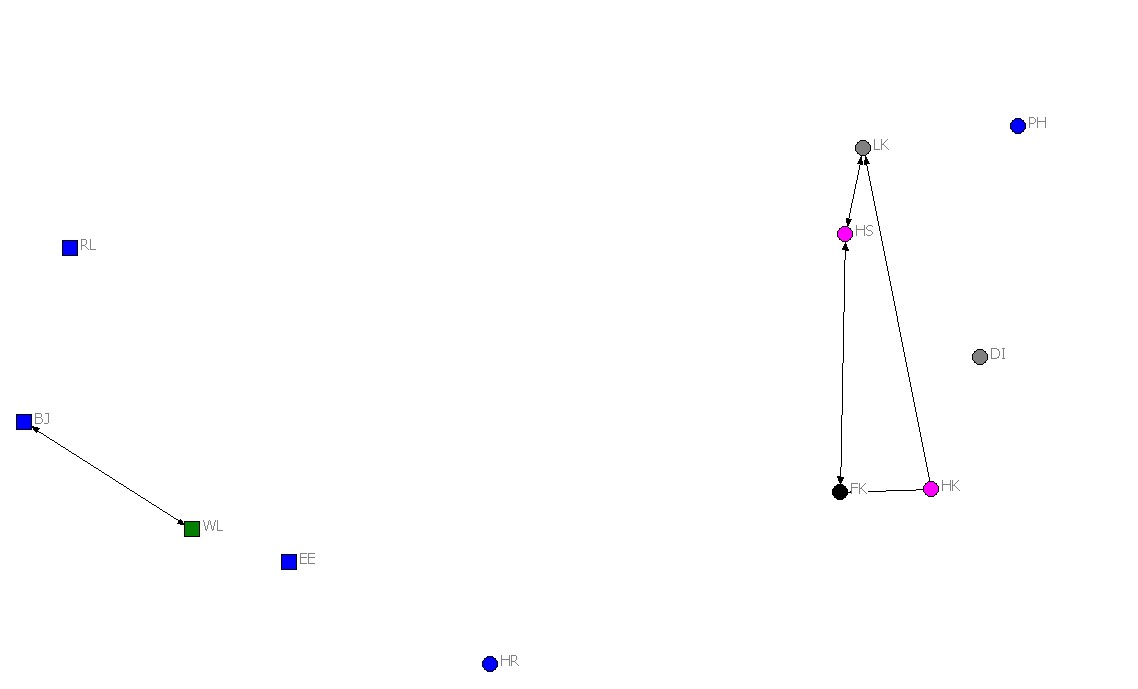
We just found that IT guys in the US office do not communicate much (what I mean by "much" is that have more than 4 lines) with other consultants. In addtion, people who are working in government sector in the US office also do not have any presence in the communication network. We think this can be problematic to the organization because health and pharmaceuticals sectors need information about technological change and government regulation so they need to co-work and communicate with each other.

(Green color is government sector and red is IT sector but there is no green and color in the picture, left side is European office and right side is the US office)


Also we have found that women in both offices do not play a central role in communication. It is even worse in European office because if we take out women in European office it makes little effect in overal communication.


(Purple : Healthcare, Green : Government, Red : IT, Gray : Oil & Gas, Black : Pharmaceuticals, Blue : Industrial)

Best regards,

Mario, Christophe, Hyunsoo

UCINET DENSITY / AVERAGE MATRIX VALUE

All,

Having a closer look at the density from UCINET, the 0.0812 takes directed connections into consideration. Means there are two possible connections between A and B (from A to B and from B to A).

The formula for possible connection is n(n-1) for directed connections and n(n-1)/2 for undirected connection.

Cheers,
MicHHaeL

Density No. of Ties
-------------- --------------
testGE4 0.0812 168.0000

NETDRAW - A Practical Guide to Visualising Social Networks

All,

Following the link you can download a pdf with a basic guide to Netdraw.

Have fun,
Michael
HH, ER must be IT guys. They do not like people. (W. says it is okay that I write this)

Friday, November 12, 2010

Businesses Need to Think Like the Media

Hi everyone. We, MBA students at HHL, are going to start our Social Network course next week. Therefore, I wanted to share the following podcast from Harvard Business School which I found very interesting with y'all.

I follow this podcast called HBR Idecast weekly. And it happened that last week's podcast was related to why businesses need to think their strategies considering Media. It last some minutes and gives a very good insight from the author on the trends of how Social Networks could provide wide ranges of opportunities, or risks if they are not considered.

Sunday, January 17, 2010

Haiti: Twitter, texting, and Micropayments

Click on the post title for a good survey of how SNs and mobile payments are shaping the relief efforts in Haiti.

Wednesday, January 6, 2010

"Biologists have figured out the most efficient way to destroy an ecosystem — and it’s based on the Google search algorithm."

Yes, the Google PageRank algorithm, that most-prominent example of a test of eigenvector centraility, is being used to determine which species of plants and animals are crucial to the survival of large ecosystems, eventually for all human life.

Click on the post title above to see the article in Wired, and if you don't remember what eigenvector centrality is, review your notes from the course. Isn't it about time to do that, anyway?

See you in a few weeks,
Prof. Tunnard

Friday, January 1, 2010

The power of crowdsourcing

Interesting article in December's HBR about networking and the benefit of Enterprise 2.0 tools. See the link in the title.